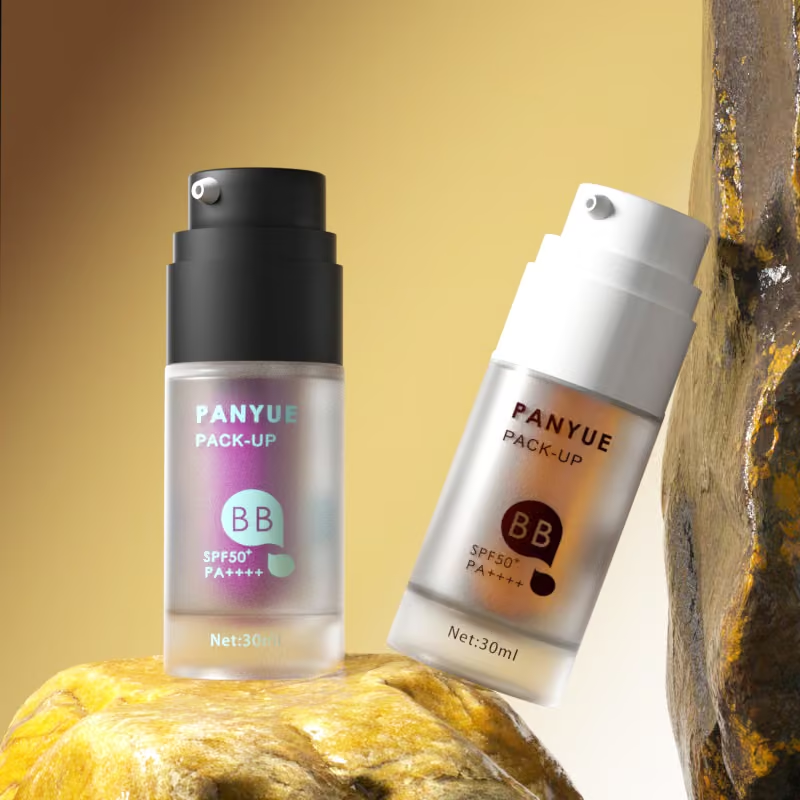
Skincare packaging does more than hold a formula. It affects how a product is dispensed, how often the formula comes into contact with the outside environment, and how much product consumers can use before the package is empty.
This is one reason airless pump bottles have become a popular option for facial creams, 혈청, eye treatments, 그리고 다른 스킨케어 제품들.
Unlike a traditional lotion pump that usually uses a dip tube, an airless system moves the product upward through a sealed dispensing structure. Depending on the design, it uses either a moving piston or a flexible inner pouch to follow the product as it is dispensed.
But how does this mechanism actually work? And how should skincare brands choose between different airless pump designs?
This guide explains the working principle, compares the two main systems, and covers the practical details buyers should check before placing a packaging order.
What is an Airless Pump Bottle?
An airless pump bottle is a dispensing container designed to limit the exchange of outside air with the product during normal use.
A conventional lotion pump generally draws product through a dip tube. As the product leaves the bottle, air enters through a venting system to replace the lost volume.
An airless pump bottle works differently. Its internal structure moves the remaining formula toward the pump outlet without relying on outside air entering the main product chamber to replace the dispensed product.
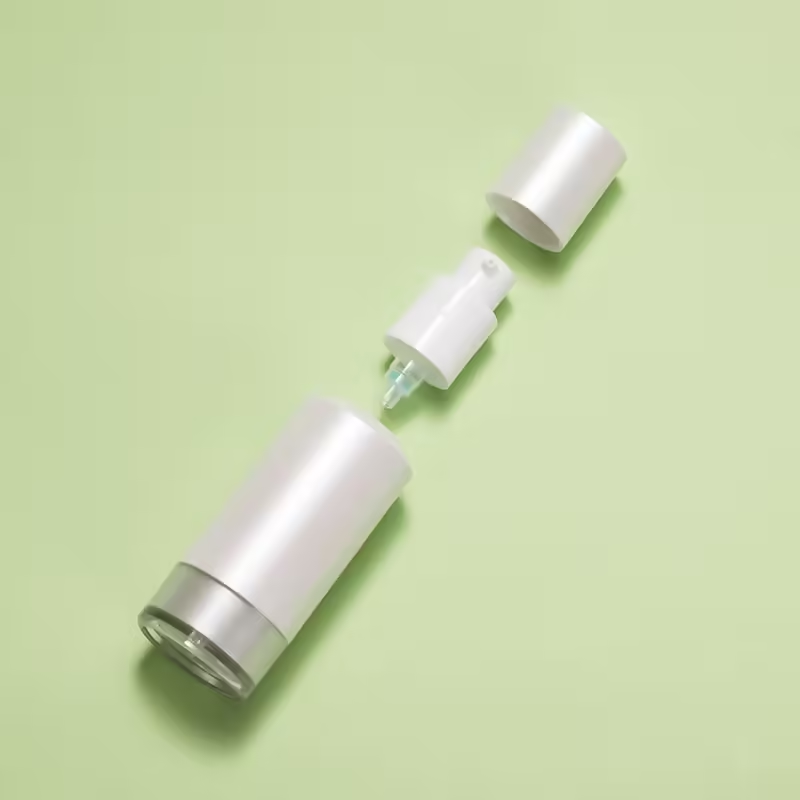
Most airless packaging systems include several components:
- Actuator: The part pressed by the user to dispense the formula.
- Pump engine: Controls the dispensing process and the amount released per stroke.
- Valve system: Regulates product flow and helps prevent backflow.
- Product chamber: Holds the skincare formula.
- Piston or flexible pouch: Moves or contracts as the product is used.
- Outer bottle: Protects and supports the internal structure while providing space for decoration.
- Overcap: Covers the actuator during storage and transport.
The outer container may be made from plastic, 유리, 알류미늄, or a combination of materials. The dispensing mechanism and the outer bottle material are separate design considerations.
It is also important to understand that “airless” does not mean the package is completely free of oxygen or sterile. The actual protection depends on the pump structure, sealing performance, material selection, and the formula itself.
How Does an Airless Pump Bottle Work?
The dispensing process is based on pressure changes inside the pump engine and movement within the product chamber.
When the user presses the actuator, the pump mechanism moves and creates the pressure needed to dispense a measured amount of product through the outlet. When the actuator returns, the pump chamber prepares for the next dispensing cycle.
At the same time, the internal product container adjusts to the decreasing product volume.
There are two common ways to achieve this:
- In a piston system, a movable disc rises as the product is dispensed.
- In a pouch system, a flexible inner bag contracts as the formula leaves it.
Both designs help reduce the need for outside air to enter the main product chamber.
The exact valve arrangement and internal construction can vary between pump models, so the structure should always be checked against the actual supplier’s technical drawing or sample.
How Does Airless Packaging Help Protect Skincare Formulas?
Airless packaging can offer several practical benefits, but it is important to understand what the mechanism can and cannot do.
Reduced Exposure to Outside Air
Some skincare ingredients are sensitive to oxygen. Oxidation may affect a formula’s color, odor, 모습, or performance over time.
Because an airless system limits the exchange of outside air with the main product chamber during normal dispensing, it can help reduce repeated air exposure.
하지만, the level of protection depends on the complete package design. Pump seals, valves, product-contact materials, and the barrier properties of the container all matter.
More Hygienic Dispensing
Unlike an open cosmetic jar, an airless pump allows consumers to dispense the formula without repeatedly touching the remaining product.
The pump structure can also help limit product backflow, depending on its valve design.
This makes airless packaging a practical option for products where controlled, touch-free dispensing is preferred.
It is not a sterilization method, though. Proper filling conditions, preservation systems, and microbiological testing are still necessary.
Better Control Over Product Dosage
A well-matched airless pump can deliver a relatively consistent amount of product with each full stroke.
This is useful for skincare products such as eye creams, facial treatments, and moisturizers, where consumers prefer predictable application.
Actual output depends on the pump specification, formula viscosity, operating conditions, and whether the pump has been properly primed.
Less Product Left Behind
In a piston system, the moving piston follows the product toward the pump. In a pouch system, the flexible bag contracts as the formula is used.
Both designs can help reduce product residue compared with some conventional containers.
하지만, no airless package should be assumed to have zero residue. The actual evacuation rate needs to be measured using the specific formula and package combination.
Light Protection Depends on the Container
One point buyers should not overlook: airless technology does not automatically protect a formula from light.
Light protection comes from the bottle material, 색상, wall thickness, coating, and overall package construction.
For light-sensitive skincare products, brands may consider amber glass, colored glass, opaque plastic, or suitable protective coatings. The level of protection should be verified for the actual formula and packaging design.
Airless Pump Bottles vs. Lotion Pumps, Droppers, and Cosmetic Jars
Different packaging formats serve different product requirements. Airless packaging is not necessarily the best choice for every skincare formula.
| Evaluation Criteria | Airless Pump Bottle | Traditional Lotion Pump | 스포이드 병 | Cosmetic Jar |
| Dispensing Mechanism | Vacuum-driven;an internal piston rises or an inner pouch collapses to push the formula upward | Dip-tube suction;outside sir enters through a venting system to replace dispensed volume. | Rubber bulb suction;requires unscrewing the cap and exposing the bottle during each use. | Wide mouth open container;requires direct scooping with fingers or a spatula. |
| Oxygen Barrier | Very High(Prevents air backflow ,minimizing oxidation throughout product use) | 낮은(Continuous air intake exposes the remaining formula to oxygen) | 낮은(Opening the bottle repeatedly exposes the entire formula to ambient air) | Very Low(Large surface area exposed to air,accelerating oxidation) |
| Hygiene&Contamination Control | Very High(Touch free dispensing paired with a one-way valve to prevent backflow) | Moderate to High(Touch free dispensing,though vented air can introduce airborne particles) | 낮음~보통(Pipette may contact skin or surfaces,risking cross-contamination upon reinsertion) | 낮은(Direct contact with fingers,dust,and moisture can contaminate the bulk formula) |
| Product Evacuation Rate | 높은(Typically>95%)(Piston or pouch tracks the formula upward,leaving minimal residue) | 낮음~보통(Formula often remains at the bottom/corners;struggles with near the end) | 보통의(Small amounts of serum at the bottom are difficult to draw up with the pipette) | 높은(Wide opening allows user to scoop or wipe out virtually all product) |
| Compatible Viscosity | Medium to High(Lotions,face creams,젤,sunscreens,liquid foundations) | Low to Medium(Standard body lotions,facial cleansers body wash,fluid emulsions) | Low Viscosity/Fluid(Facial oils,water-thin serums,liquid concentrates) | High Viscosity/Pastes(Rich creams,cleansing blams,wash off masks,body scrubs) |
| Packaging&Filling Cost | Higher (precision components;certain designs require specialized vacuum filling lines) | 낮은(Mature supply chain;compatible with standard high speed filling equipment) | 보통의(Typically glass based;moderate assembly and transit breakage protection costs | 낮은(Simple structure,easy to fill,and cost effective for large capacities or decoration) |
| Ideal Applications | Oxygen sensitive actives(Retinol,Vitamin C,펩타이드)and prestige treatment lines | Everyday moisturizers,body care,and mass market personal care products | Low viscosity facial oils,watery serums,and formulas marketed around drop by drop dosing | Heavy anhydrous balms,thick barrier creams,clay masks,and granular scrubs |
Selection Takeaway: For formulas containing oxygen-sensitive actives with an emulsion or cream texture, airless pump bottles offer the highest stability and evacuation efficiency. For water-thin fluids, brands should run compatibility and dosing trials comparing traditional dropper bottles against specialized low-viscosity airless or pouch systems.
Choosing a Glass Airless Pump Bottle
Key Factors for Skincare Brands to Consider Before Ordering
Glass airless pump bottles are often selected by brands looking for a premium appearance combined with a controlled dispensing system.
A common design combines a glass outer bottle with a plastic inner component or refill container. This structure allows the exterior to provide the desired visual presentation while the internal components perform the dispensing function.
When comparing glass airless packaging options, buyers should consider the following factors.
1. Bottle Capacity and Shape
Choose a capacity that fits the intended product and usage period. Common skincare packaging sizes vary by application, so confirm the available options with the supplier.
The bottle shape should also leave sufficient internal space for the pump and product chamber.
2. Outer Bottle Material and Finish
Glass offers a substantial feel and a premium appearance. It can also support different decorative treatments, depending on the glass type and production process.
Options may include clear, 희게 센, colored, sprayed, or printed finishes. Confirm the available process and sample quality before selecting a final design.
3. Pump Compatibility
The pump must match the formula’s viscosity and dispensing requirements.
Check the output per stroke, priming performance, dispensing consistency, and compatibility with the product-contact materials.
4. Inner Structure and Refill Design
For refillable packaging, confirm whether the inner container can be removed and replaced without damaging the outer bottle or pump assembly.
Also check how the refill is secured, whether the components can be cleaned where necessary, and whether the replacement unit maintains reliable sealing and dispensing performance.
5. Decoration and Brand Identity
The outer glass bottle can be customized to match a brand’s visual identity. Depending on the product and manufacturing process, decoration options may include color spraying, silk-screen printing, 핫 스탬핑, and other surface treatments.
Request a physical sample to evaluate color, print adhesion, finish consistency, and the overall appearance before mass production.
FAQ
Do airless pump bottles really keep air out?
They are designed to reduce the exchange of outside air with the main product chamber during normal use. 하지만, they are not necessarily completely oxygen-free or hermetically sealed. Actual performance depends on the pump, valves, seals, and packaging materials.
Are airless pump bottles suitable for thick creams?
Many piston-based airless systems are used for creams and lotions, but not every pump can handle every viscosity. Formula flow behavior, pump dimensions, and dispensing performance should be tested together.
Can airless pump bottles be made with glass?
Yes. Some designs use a glass outer bottle combined with plastic internal components. The glass provides the exterior appearance, while the pump and inner structure handle product storage and dispensing.
Are airless pump bottles refillable?
Some are designed with replaceable inner containers or refill components. Others are not. Buyers should confirm the refill structure, component compatibility, and replacement process with the supplier.
Do airless bottles extend the shelf life of skincare products?
Airless packaging may help reduce repeated air exposure and direct contact during use, but it does not independently determine shelf life. The formula, preservation system, container materials, storage conditions, and stability testing all contribute.
How much product remains inside an airless bottle?
There is no universal residual-product figure. The result depends on the bottle design, piston or pouch structure, pump inlet, formula viscosity, and usage conditions. Ask for test results based on the actual package and formula.